What hedge trimming and cutting involves
A well-kept hedge is one of the nicest boundaries a garden can have: private, good for wildlife and softer than a fence. The catch is that hedges don’t stay put. Skip a year or two and a neat screen can become a wide, top-heavy wall that shades the garden and hangs over the pavement.
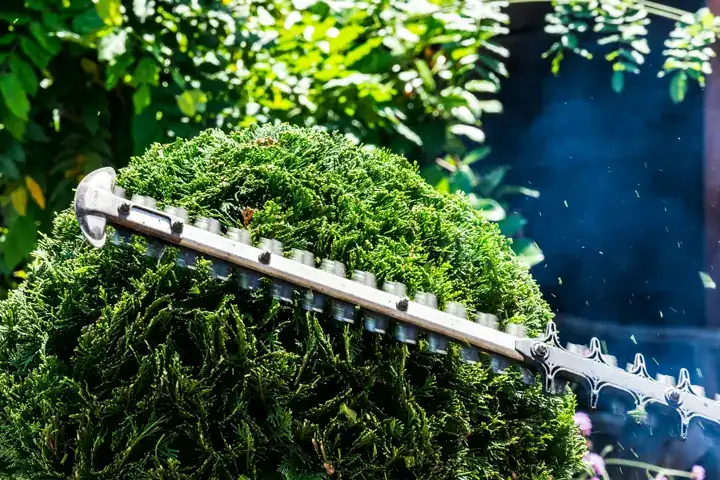
- Routine trimming of the sides and top to keep a hedge dense and in shape.
- Height reduction of tall hedges and conifer screens, using towers or platforms where needed.
- Width reduction to reclaim garden space or clear a path, drive or pavement.
- Renovation of overgrown broadleaved hedges, often spread over two seasons.
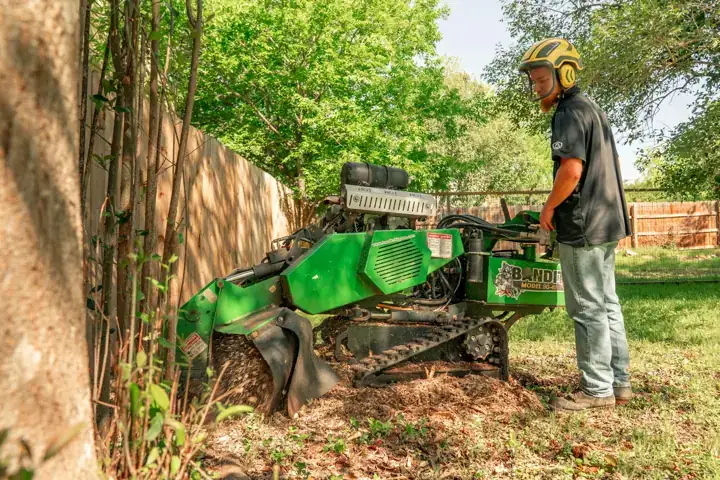
- Hedge removal, including grinding out the stumps so the line can be replanted or fenced.
When you need it: signs to look for
- The hedge is too tall to trim safely from a stepladder.
- It has grown wide enough to narrow the garden, a path or the pavement. Essex Highways asks owners to keep vegetation back to the boundary and 2.4m clear above pavements (Essex Highways (opens in a new tab)).
- The top is thicker than the bottom, so the base is going bare.
- It’s blocking light to your house or a neighbour’s, or causing a dispute.
- Gaps and dieback, which may mean renovation or replacement rather than trimming.
Regular light trims are usually kinder to a hedge than letting it grow for several years and then needing a major reduction. Many garden hedges are trimmed once or twice a year; faster-growing conifers and laurel may need more attention to stay in shape.
Conifers and Leylandii: know the limits
Leyland cypress (Leylandii) and many other conifers are fast-growing and popular for quick screening, but most won’t regrow from old, brown wood. If a conifer hedge is cut back beyond the green foliage, it often stays bare. The answer is usually to reduce the height with care and keep the sides trimmed lightly and regularly. If a conifer hedge has got completely out of hand, removal and replanting with a more forgiving species can be the better long-term option. Broadleaved hedges such as beech, hornbeam, privet and hawthorn are generally more tolerant of hard cutting.
The process with a tree surgeon or hedge specialist
- Enquiry with the rough length and height, hedge type if known, and photos of the whole length.
- Access check: whether both sides need doing, and whether the far side is a neighbour’s garden, a road or a footpath.
- Written quote stating the finished height and width and what happens to the cuttings.
- Nest check before any cutting, and a later date if birds are nesting.
- The work, using hedge trimmers, and chainsaws or platforms for big reductions.
- Clear-up: cuttings are raked out of the hedge base and removed or bagged.
What affects a hedge cutting quote
- Length, height and width of the hedge.
- Type: conifers and laurel produce a lot of bulky waste; formal hedges need more care.
- How overgrown it is: a routine trim is quicker than a major reduction.
- Access to both sides, and whether towers or a platform are needed.
- Waste: removal of cuttings is often a big part of the job.
Nesting birds, neighbours and the law
Nesting birds
Hedges are prime nesting habitat. Under the Wildlife and Countryside Act 1981 it’s an offence to intentionally damage or destroy a wild bird’s nest while it’s in use or being built. The RSPB recommends not cutting hedges between March and September and cutting between 1 September and 28 February instead, while still checking for nests (RSPB (opens in a new tab)). See our nesting birds guide.
High hedges and neighbours
Chelmsford City Council can consider a formal complaint about a hedge on someone else’s land that is made up of two or more evergreen or semi-evergreen plants, over two metres high, and obscuring light or views, once you’ve tried to settle it, including mediation. There is a charge (Chelmsford City Council (opens in a new tab)). Our neighbour’s trees guide explains the steps.
Protected trees and countryside hedgerows
Trees within a hedge can have a TPO or be in a conservation area. Some rural hedgerows are protected and need an application before removal (countryside hedgerows (opens in a new tab)).
Questions to ask
- What finished height and width will you cut to?
- Will you check for nests first?
- Will you cut both sides, and do you need access to my neighbour’s garden?
- Are the cuttings taken away?
- Can I see your insurance?
Local notes for Chelmsford, Essex
Conifer screens and laurel hedges are a familiar sight on Chelmsford estates such as Chelmer Village and around Springfield, while rural parishes such as Boreham, Roxwell and the Hanningfields have more mixed field-edge hedgerows. If you subscribe to the city council’s garden waste collection, hedge cuttings can go in the brown bin, but bulky reductions usually need the contractor to take the waste. See our garden waste guide.
Would you like a free quote?
Tell us about the job and we’ll pass it to an independent local tree surgeon covering your part of Chelmsford.
Frequently asked questions
When is it best to cut a hedge?
The RSPB recommends avoiding hedge cutting between March and September, the main nesting season, and cutting between 1 September and 28 February, while still checking for nests. Legally you can cut at other times as long as no active nests are damaged.
Can an overgrown hedge be cut back hard?
Many broadleaved hedges, such as beech, hornbeam, privet, hawthorn and yew, respond well to hard reduction, sometimes spread over two seasons. Most conifers, including Leyland cypress, don’t regrow from old brown wood, so cutting them back too far can leave permanent bare patches.
My neighbour’s hedge is too tall. What can I do?
Try to agree a solution first. Chelmsford City Council can consider a formal complaint about a hedge of two or more evergreen or semi-evergreen plants over two metres tall, once you’ve tried to resolve it (it expects evidence covering three months, including mediation). There is a charge. See our neighbour’s trees guide.
Do I need permission to remove a hedge?
Garden hedges generally don’t need permission. Countryside hedgerows can be protected, and Chelmsford City Council says you need to apply before removing one. See its countryside hedgerow (opens in a new tab) page.
Can hedge cuttings go in my brown bin?
Yes, if you subscribe to Chelmsford City Council’s garden waste collection: hedge cuttings are on its list for the brown bin, which must have its lid closed. Bulky loads can go to an Essex recycling centre, or ask for the tree surgeon to take them. See our garden waste guide.
How high should a hedge over a pavement be kept?
Essex Highways asks owners to keep vegetation back to the property boundary and to leave 2.4m clearance over pavements and cycleways.
Is the waste taken away?
Hedge trimmings are bulky, so check the quote says whether cuttings are collected and removed or left for you.