What tree removal involves
Tree removal means taking a tree down to a low stump, safely and in a controlled way, and dealing with the brushwood and timber. There are two main methods, and the choice mostly comes down to space.
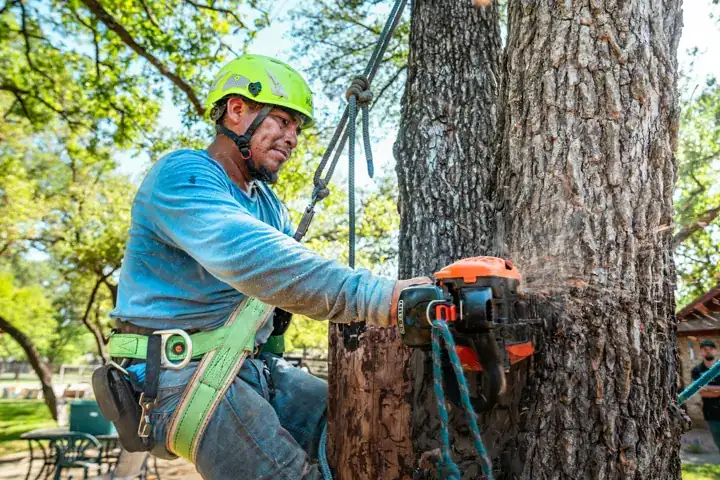
Straight felling is used where there is a clear drop zone at least as long as the tree is tall. The tree surgeon cuts a notch and a hinge at the base so the tree falls in a planned direction. It is quicker, but it is more common on larger rural plots than in town gardens.
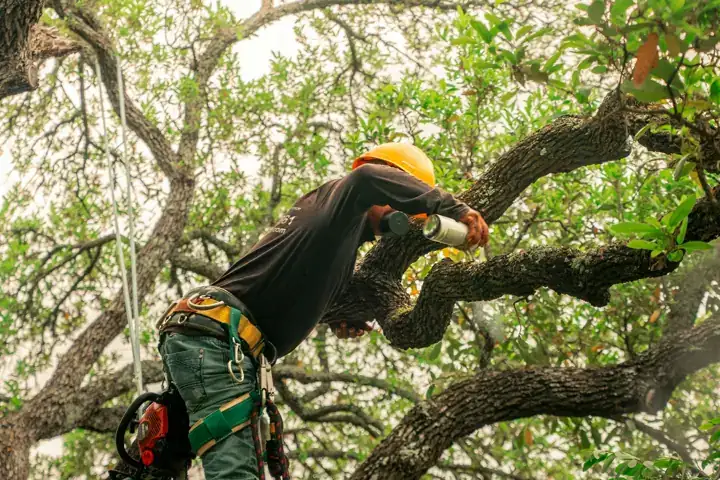
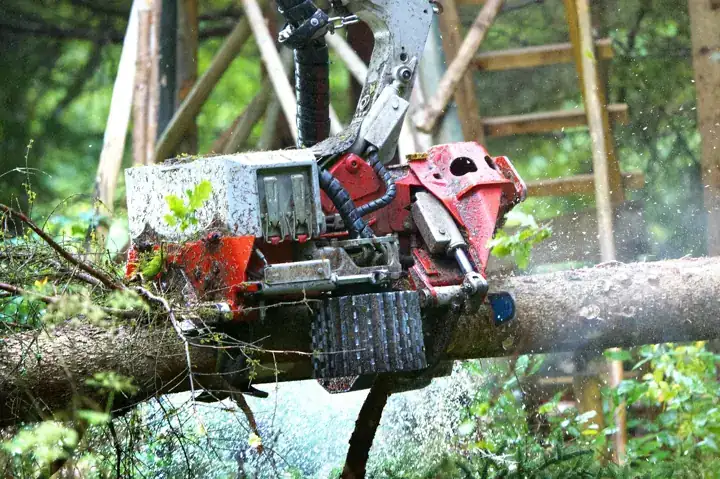
Sectional dismantling is how most trees in Chelmsford gardens come down. A climber, or a machine-mounted platform where access allows, removes the tree from the top in manageable pieces. Heavier sections are lowered on ropes (rigging) so they don’t land on roofs, conservatories, sheds, fences or a neighbour’s greenhouse. The trunk is then cut down in rings to a low stump.
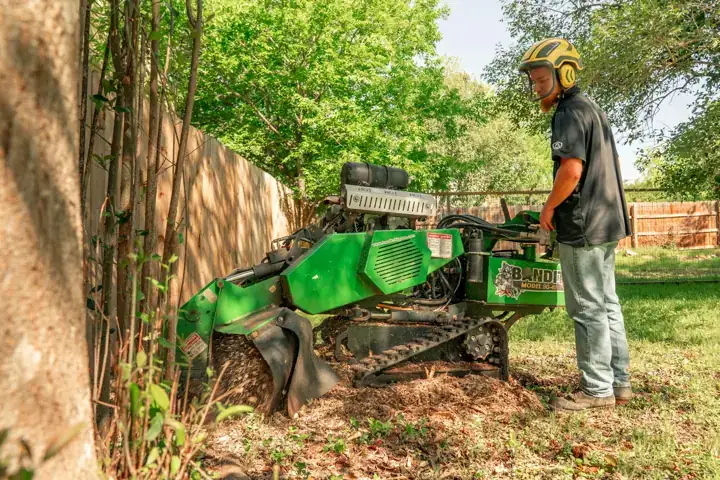
Brushwood is chipped on site; timber can be taken away or left as logs. The stump stays unless you ask for stump grinding.
When removal is the right call: signs to look for
A good tree surgeon won’t push you into felling. Often a crown reduction or thinning solves the real problem while keeping the tree. Removal becomes the sensible option when you notice things like:
- Dead or dying trees: no leaves in summer, bark falling away, or large areas of dead crown.
- Fungus and decay: brackets or mushrooms at the base or on the trunk, soft or hollow wood, or cavities.
- Structural problems: deep cracks, split unions between stems, or a lean that has recently got worse, especially with lifting or cracked soil at the base.
- Serious storm damage that can’t be made safe with pruning. See emergency and storm-damaged trees.
- Disease: for example ash trees in marked decline. Our ash dieback guide explains the signs.
- Wrong tree, wrong place: a fast-growing conifer or large species planted too close to the house, drains or boundary.
Unsure? Describe what’s worrying you, with photos, and the tree surgeon can talk you through the options.
The process with a tree surgeon
- Enquiry. Send your postcode, a description and a couple of photos (one of the whole tree and its surroundings, one closer up).
- Assessment. The tree surgeon looks at the tree in person or from photos, checks access and what’s underneath, and decides on felling or dismantling.
- Written quote. It should say exactly which tree, the method, what happens to the stump and waste, and when they could do it.
- Checks. Protection status (TPO or conservation area) is confirmed, and consent or notice arranged if needed. The tree is checked for active nests and signs of bats before work.
- Preparation. Parking, access through the side gate, protection for lawns and borders, and a word with neighbours if branches overhang or ropes will cross a boundary.
- On the day. A work zone is set up, the tree is felled or dismantled, and brash is chipped as the job goes.
- Clear-up. Timber and chippings are removed or left as agreed, and the site is raked and blown clean.
What affects a tree removal quote
We don’t publish prices because no two removals are alike. The things that make the biggest difference are:
- Size: height, spread and trunk diameter.
- Method: straight felling is usually quicker than dismantling and rigging over structures.
- Access: a narrow side passage, steps, or a back garden with no vehicle access means more time carrying and chipping.
- What’s underneath or nearby: roofs, glasshouses, walls, a road, or overhead cables. Work near power lines may need the network operator to be involved first.
- Condition: dead, decayed or storm-damaged trees can be less predictable and slower to take down safely.
- Waste and extras: whether brushwood, logs and chippings are taken away, and whether stump grinding is included.
Safety, permissions and who is responsible
Protected trees
Chelmsford City Council says a tree is protected if it has a Tree Preservation Order (TPO) or stands in a conservation area; conservation-area trees more than 7.5cm in diameter at 1.5 metres above the ground are protected as if they had a TPO. You normally need the council’s consent (TPO trees) or must give six weeks’ notice (conservation-area trees) before work. Check the council’s TPO register (opens in a new tab) or read our TPO and conservation area guide.
Felling licences
The Forestry Commission says a felling licence is not required for felling trees in gardens, churchyards or public open space. Larger felling on other land can need one, so ask if you own woodland or farmland. Source: GOV.UK felling licence exemptions (opens in a new tab).
Nesting birds and bats
Under the Wildlife and Countryside Act 1981 it is an offence to intentionally take, damage or destroy a wild bird’s nest while it is being built or in use, and all bat species and their roosts are protected. GOV.UK says offences can bring an unlimited fine and up to six months in prison. The RSPB describes March to September as the main nesting season. See our nesting birds and bats guide.
Who is responsible for a tree?
Chelmsford City Council says the owner of the land a tree stands on is responsible for it, whether that’s you, a neighbour, Essex County Council (highway verges), the city council (parks) or a parish council (trees and hedges (opens in a new tab)).
Trees near houses on clay
The British Geological Survey says soils most susceptible to shrink–swell are found mainly in south-east England, and that removing or severely pruning trees can change ground movement. If a large tree is close to your house and you suspect subsidence, talk to your insurer and a structural engineer before felling (BGS: shrink–swell (opens in a new tab)).
Questions to ask a tree surgeon
- Can I see your public liability insurance and NPTC (City & Guilds) certificates for chainsaw and climbing work?
- Will you fell or dismantle the tree, and how will you protect buildings, fences and plants?
- Have you checked whether the tree has a TPO or is in a conservation area? Who will handle any application?
- Will you check for nesting birds and bats before starting?
- What happens to the stump, brushwood, logs and chippings?
- Is everything in a written quote, including clear-up?
Please make these checks yourself, whoever you use. The Arboricultural Association (opens in a new tab) explains what to look for.
Local notes for Chelmsford, Essex
Much of Chelmsford’s older housing, around Moulsham, the West End and off the Springfield Road, has small back gardens reached through a side passage, so sectional dismantling with everything carried out by hand is common. Newer estates at Chelmer Village and Beaulieu often have trees planted close to houses and fences that outgrow their space. Larger plots in the rural parishes, such as Roxwell, Little Baddow or Great Waltham, are more likely to allow straight felling.
Chelmsford has conservation areas in the city centre and many villages, including Writtle, Great Baddow, Broomfield, Danbury and Stock, so checking protection is a normal first step. Ingatestone (Brentwood) and Hatfield Peverel (Braintree) come under their own councils.
Would you like a free quote?
Tell us about the job and we’ll pass it to an independent local tree surgeon covering your part of Chelmsford.
Frequently asked questions
How long does it take to remove a tree?
It depends on the size of the tree, the method and the access. A small garden tree might take a couple of hours; a large tree that has to be dismantled piece by piece over a roof can take a full day or more. The tree surgeon will tell you what to expect when they quote.
Will the stump be removed too?
Not automatically. Felling normally leaves a low stump. If you want it gone, ask for stump grinding to be included in the quote, or leave the stump if you’re happy to keep it.
Do I need permission to remove a tree in Chelmsford?
You need consent from Chelmsford City Council if the tree has a Tree Preservation Order, and you must give six weeks’ notice before working on trees in a conservation area. Check the council’s TPO register (opens in a new tab) first, or read our guide to TPOs in Chelmsford.
Do I need a felling licence for a tree in my garden?
Generally not. The Forestry Commission says a felling licence is not required for felling trees in gardens, though TPO and conservation-area rules still apply. See GOV.UK: when a felling licence is not required (opens in a new tab).
Can a tree be removed if it’s close to my house or a neighbour’s fence?
Usually, yes. That’s what sectional dismantling is for: the tree is taken down in small, controlled pieces, often lowered on ropes, so nothing falls on buildings, fences or plants.
What happens to the wood?
Most tree surgeons chip the brushwood on site and take it away. Larger timber can be removed, cut into logs, or left for you if you have a wood burner. Say what you’d prefer when you ask for the quote. Our garden waste guide explains your own disposal options.
Can I cut down a tree near the house if I suspect subsidence?
Get advice first. The British Geological Survey notes that removing trees on shrinkable clay can cause the ground to swell (heave) as it rewets. If subsidence is suspected, speak to your insurer and a structural engineer before felling.