What stump grinding involves
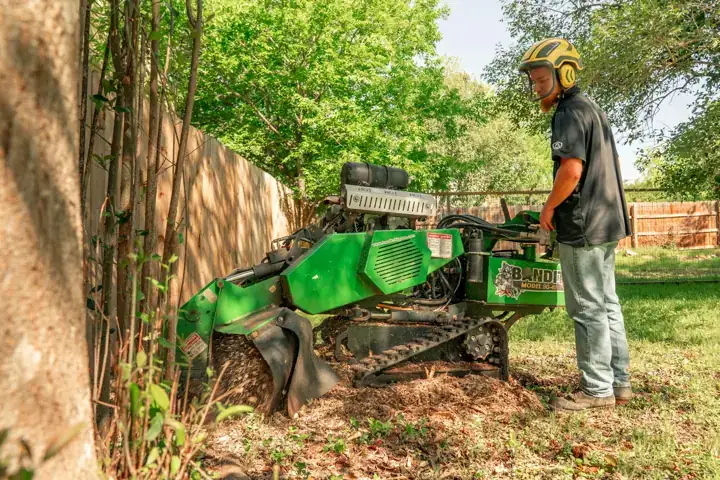
Stump grinding removes a tree stump below ground level using a machine with a rotating toothed cutting wheel. The wheel is swept from side to side across the stump, chipping it away in layers until it sits below the surface. What’s left is a hole filled with wood chip and soil that can be levelled, topped with soil and turfed or planted.
It is the usual way to deal with stumps in gardens because it is quick, leaves the surrounding lawn largely intact, and doesn’t need the whole root plate dug out. Surface roots running from the stump can be followed and ground out too. Stumps from trees felled years ago can be ground just as well as fresh ones.
Grinding or full stump removal? People often use the terms interchangeably, but full removal means digging or winching out the stump and main root plate. That leaves a much bigger hole and more disturbance, so it’s usually reserved for building work where foundations or a new drive need the ground clear. For lawns, beds and patios, grinding is normally enough. If you’re not sure which you need, tell the tree surgeon what you plan to do with the space and they can advise.
When you need it: reasons to remove a stump
- It’s in the way of a new lawn, bed, patio, shed or path.
- Trip hazard or mowing obstacle, particularly low stumps hidden in grass.
- Regrowth: some species keep sending up shoots from the stump or roots.
- Decay and fungi: honey fungus, a common and damaging garden fungus, can live on dead stumps and roots and spread to nearby plants.
- Replanting: you want a new tree nearby. Offsetting it from the old stump position is usually better.
If you’re happy with a stump (some people keep them as wildlife habitat or a seat), there’s no obligation to remove it.
The process with a tree surgeon
- Enquiry. Say how many stumps, the rough diameter of each (a tape measure across the top is perfect), the narrowest access width, and send a photo of each stump with something for scale.
- Services check. The operator asks about underground pipes, drains and cables near the stump. Tell them anything you know.
- Preparation. Stones and debris are cleared, and the stump may be cut lower with a chainsaw.
- Grinding in layers to the agreed depth, including surface roots if agreed.
- Tidy up. Grindings are raked back into the hole, left as mulch, or taken away.
What affects a stump grinding quote
- The number of stumps and the diameter of each.
- How deep you need the grinding to go (turf, planting or building).
- Access: gate width, steps, slopes and soft lawns affect which machine can be used.
- Hardwood versus softwood, and whether the stump is fresh or old.
- Surface roots to be followed out.
- Whether grindings are taken away, and whether it’s combined with a tree removal in one visit.
Safety and legal points
Stump grinders throw debris, so the work area is kept clear of people, pets, cars and windows, and screens may be used. Underground services are the main hazard, which is why the operator will ask what runs near the stump.
If a stump belongs to a tree that was protected, check the conditions of any consent. Chelmsford City Council says a tree felled under a five-day dead or dangerous notification must normally be replaced, and the replacement is automatically protected (dead or dangerous protected trees (opens in a new tab)). See our TPO guide.
Wildlife: stumps and root plates can shelter wildlife, and nearby shrubs may hold nests in spring and summer. See our nesting birds guide.
After grinding: what next?
- Turfing or seeding: remove most of the wood chip, fill with topsoil, firm it down and allow for a little settling.
- Replanting: old roots and wood chip take time to break down, so offset a new tree a little.
- Paving or building: tell the tree surgeon in advance. Deeper grinding may be needed, and your builder may want major roots removed.
Questions to ask
- How deep will you grind, and will you follow surface roots?
- Will your machine fit through my gate? (Give the width.)
- Do you need to know about pipes or cables first?
- What happens to the grindings?
- Can I see your insurance?
Local notes for Chelmsford, Essex
Much of Chelmsford’s housing, from the terraces around Moulsham and the Springfield Road area to newer estates at Chelmer Village and Beaulieu, only has side-passage access to the back garden. That’s fine for most stump work, as compact walk-behind grinders are built for exactly this, but larger machines need wider access. Wet ground in winter can make lawns soft, so ask how the ground will be protected.
Would you like a free quote?
Tell us about the job and we’ll pass it to an independent local tree surgeon covering your part of Chelmsford.
Frequently asked questions
How deep does stump grinding go?
Depth varies by machine and job. The aim is usually to go far enough below ground level to lay topsoil and turf over the spot. Ask the tree surgeon how deep they’ll grind, and say if you plan to build or plant in the same place.
Does stump grinding remove all the roots?
No. Grinding removes the stump and the top of the main root plate. The remaining roots are left in the ground and gradually decay. If you’re laying foundations, the tree surgeon or your builder can advise whether more root removal is needed.
Can a stump grinder get into my back garden?
Often, yes. Compact stump grinders are designed to fit through side gates and narrow passages. Measure the narrowest point of the access route when you enquire so the right machine can be planned.
What happens to the grindings?
Grinding produces a pile of wood chips mixed with soil. You can keep it as mulch, have it backfilled into the hole, or ask for it to be taken away. Our garden waste guide covers disposal options.
Will the stump grow back?
Some species, such as willow, poplar and sycamore, can send up new shoots from a stump or roots. Grinding below ground level greatly reduces this. Occasional shoots can be cut off as they appear.
Is it better to grind a stump or dig it out?
For most garden stumps, grinding is quicker, less disruptive and leaves a much smaller hole than digging. Digging out the whole root plate is usually only needed for construction work.
Do I need permission to grind a stump?
Not usually for the stump itself once a tree has been lawfully felled. But if a protected tree was removed under consent or a dead or dangerous notification, the council may require a replacement tree, so check before you plant or pave over the spot.