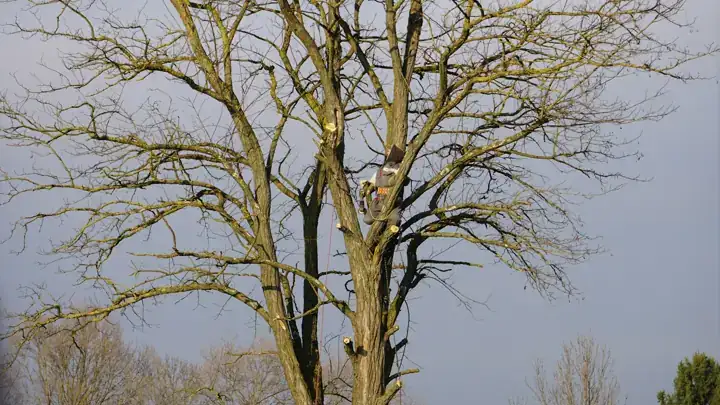
Quick facts: timing tree work
- Dormant season
- Many deciduous trees and shrubs are best pruned while dormant, when bleeding is minimised (RHS).
- Plums, cherries & Prunus
- Prune in summer: silver leaf spores are active September to May (RHS).
- Sap-bleeding trees
- Birch, walnut, maple, hornbeam, laburnum, magnolia, mulberry, poplar and lime each have their own best window, mostly summer to mid-winter; avoid mid to late winter and early spring (RHS). See the table below.
- Nesting season
- Main season March to September. The RSPB recommends cutting hedges only 1 September to 28 February (avoiding March to August where possible), still checking for nests.
- Protected trees
- Allow six weeks (conservation area) or eight weeks (TPO) for Chelmsford City Council.
- Dangerous trees
- Deal with them whenever needed. Don’t wait for winter.
Checked 28 September 2026 against: RHS: bleeding from pruning cuts (opens in a new tab); RHS: silver leaf (opens in a new tab); RSPB (opens in a new tab); Chelmsford City Council (opens in a new tab). Details can change, so confirm on the official page before you rely on them.
Who this guide is for: Chelmsford, Essex homeowners deciding when to book pruning, reductions, removals or hedge work, and anyone unsure whether their tree should be cut in winter or summer.
Why so much tree work happens in winter
For many deciduous trees, such as oak, ash, beech and apple, the dormant season has real advantages:
- You can see the structure. With the leaves off, the branch framework, deadwood, cavities and weak unions are clear, so cuts can be better placed.
- Less bleeding. The RHS says many deciduous trees and shrubs are best pruned while dormant, when bleeding is minimised (RHS (opens in a new tab)).
- Outside the main nesting season. The RSPB describes March to September as the main nesting season, so winter work carries less risk of disturbing active nests.
- Less leaf to handle. Less material to chip and move, and borders are dormant. Ground protection is still used on soft lawns.
- Ready for spring. A reduction done in winter gives the tree the spring to respond, and you get the extra light straight away.
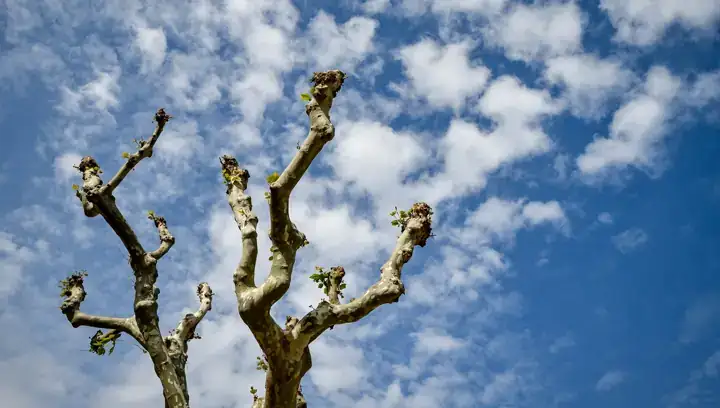
Exceptions: trees that shouldn’t be pruned in winter
- Plums, cherries and other Prunus. The RHS says silver leaf infects mainly through pruning wounds and its spores are active from September to May, so routine pruning of susceptible plants is ideally done in summer, when wounds also heal faster. It lists plums, apples, apricots, cherries, hawthorns and poplars among trees most commonly affected (RHS silver leaf (opens in a new tab)).
- Trees that bleed sap. Sap rises early in some trees, such as birch and walnut, so they bleed if pruned in mid to late winter or early spring. The RHS gives each its own timing (table below).
- Evergreen hedges and conifers are often trimmed from late summer, but that overlaps the main nesting season (March to September). Check carefully for active nests before any cut. The RSPB recommends avoiding hedge cutting from March to August where possible, and still checking in September for late broods (RSPB (opens in a new tab)). See hedge trimming.
- Dangerous trees should be made safe whenever needed. See emergency and storm-damaged trees.
RHS pruning times for trees that bleed sap
| Tree | When the RHS says to prune |
|---|---|
| Magnolia (spring-flowering) | Early to mid-summer |
| Poplar (Populus) | Late summer to early autumn (the RHS notes P. × candicans can be pruned in late winter) |
| Walnut (Juglans) | Mid-summer, before mid-winter |
| Laburnum | Late summer, before mid-winter |
| Birch (Betula) | Best avoided; otherwise late summer to mid-winter |
| Lime (Tilia) | Mid-summer to mid-winter |
| Hornbeam (Carpinus) | Late summer to mid-winter |
| Maple (Acer) | Japanese maples: after leaf fall, before January. Snakebark maples: late summer |
| Mulberry (Morus) | Autumn to early winter |
Nesting birds and bats
Active nests are protected all year under the Wildlife and Countryside Act 1981, and all bats and their roosts are protected too. Winter work reduces the risk to nesting birds, but bats can use trees in any season, so mature trees with cavities or loose bark still need checking. Our nesting birds and bats guide explains the law and the RSPB’s advice.
Planning winter work in Chelmsford, Essex
- Enquire in early autumn. Tree surgeons can get busy through the dormant season, especially after the first storms.
- Check protection early. Chelmsford City Council usually decides within six weeks for conservation-area trees and eight weeks for TPO trees (council (opens in a new tab)). See our TPO guide.
- Think about access. Wet winter ground can make lawns soft. Ask how the tree surgeon will protect it.
- Expect weather delays. High winds, ice and snow can postpone climbing work.
- Plan the waste. Winter reductions still produce a lot of brash. See our garden waste guide.
Frequently asked questions
Is winter the best time to prune trees?
For many deciduous trees, yes. The RHS says many deciduous trees and shrubs are best pruned while dormant, when bleeding is minimised. But there are important exceptions, such as plums and cherries, which the RHS advises pruning in summer.
Why shouldn’t cherries and plums be pruned in winter?
The RHS says silver leaf fungus infects through wounds, mainly pruning cuts, and its infectious spores are active from September to May, so routine pruning of susceptible trees is ideally done in summer, when wounds also heal more quickly.
Which trees bleed sap if pruned at the wrong time?
The RHS lists birch, walnut, maple, hornbeam, laburnum, magnolia, mulberry, poplar and lime (Tilia) among plants prone to bleeding, and gives each its own pruning window. For example: magnolia early to mid-summer; poplar late summer or early autumn; walnut mid-summer, before mid-winter; hornbeam and lime up to mid-winter; and birch best not pruned at all if you can avoid it.
Can tree work be done in frost or snow?
Tree surgeons may postpone work in severe frost, snow, ice or high winds for safety, as climbing and ground conditions become hazardous. A flexible date helps.
Can tree surgeons work in the rain or in winter?
Usually, yes. Light rain and cold weather don’t normally stop tree work, and many jobs suit the dormant season. Work is more likely to be postponed for high winds, lightning, ice or snow, or if the ground is so wet that machinery would damage a lawn. Ask how the ground will be protected, and keep your date a little flexible.
Is winter outside the nesting season?
Largely. The RSPB describes March to September as the main nesting season and recommends cutting hedges only between 1 September and 28 February, while still checking, because some birds nest early or breed late into September.
How far ahead should I book winter work?
If the tree is protected, allow for Chelmsford City Council’s usual six weeks (conservation area) or eight weeks (TPO) before work can start. Tree surgeons can also be busy after storms, so an early enquiry helps.
Sources
All checked 28 September 2026. We link to the official page rather than repeat details that change often.
About this guide
Written and checked by Chelmsford Tree Surgeon. We’re an online introduction service: we don’t carry out tree work ourselves, and we don’t vet, accredit or vouch for any tree surgeon. Facts are checked against the official sources listed above, and the page shows the date they were last checked. Spotted something out of date? Email hello@chelmsfordtreesurgeon.co.uk.